Email
Phone
Our live online AI and Data Science course for kids (ages 10+) helps children understand how artificial intelligence works, from data collection to model creation.
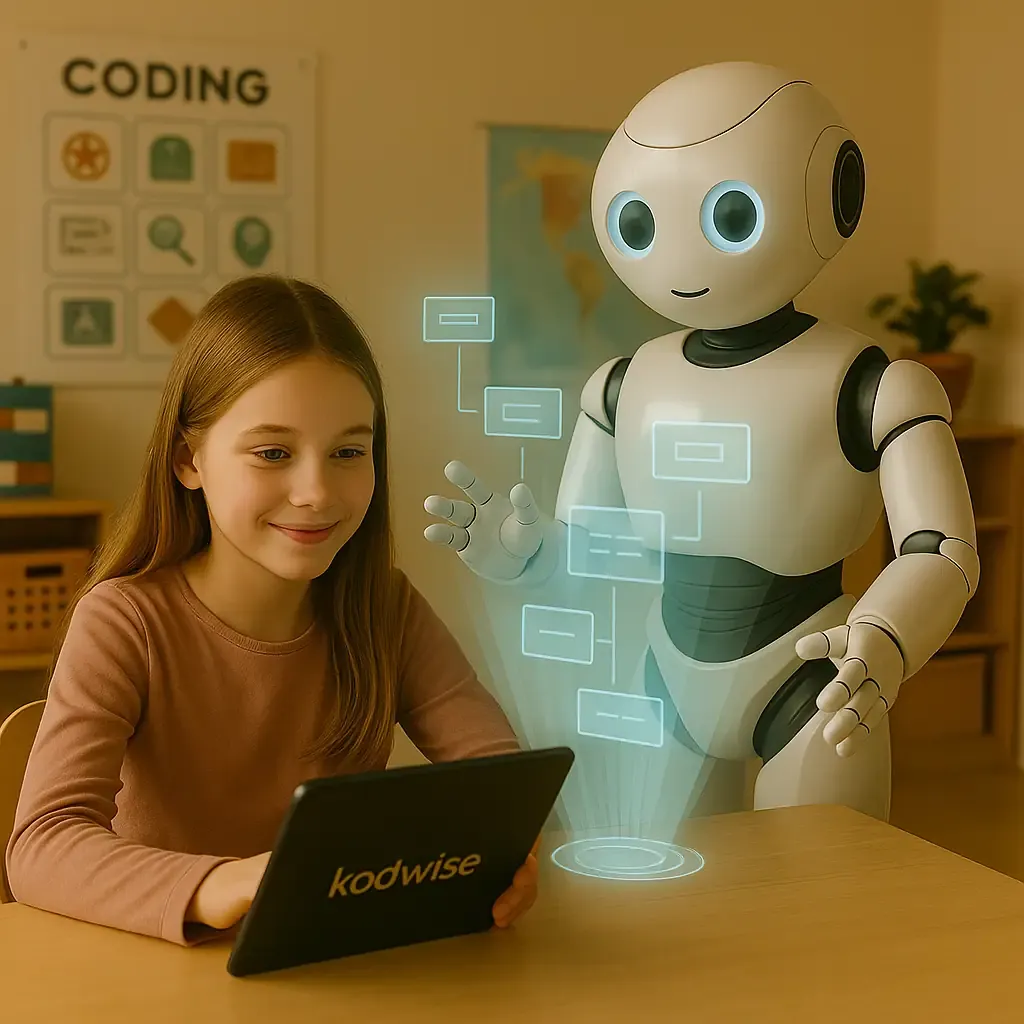
Through interactive lessons, students learn to analyze, visualize, and interpret data. They explore how machine learning models make decisions, developing logical thinking, creativity, and problem-solving along the way. For ages 10–11, completing the Python Basics program first is a prerequisite; for ages 12 and up there is no prerequisite, and the right level is determined in the free trial lesson.
Ages 10+
32 weeks · extendable with continuation levels
1-hour live class per week
5–8 students by age
32 lessons
First trial lesson is free
Weekly progress report + lesson recordings
Awarded on program completion
This program teaches how to build artificial intelligence, not just how to use it. Kids do not ask questions to a ready-made tool: they read the data themselves, clean it, visualize it, and write a model that learns from it. The tools are the same ones used in the professional world.
In the age of AI, the real divide will be between those who merely consume the technology and those who understand it. A teenager who knows how a model learns, where the data comes from and where it can go wrong stands on the right side of that divide, whatever career they choose. This program exists to build exactly that literacy, hands-on and with real tools.
The program consists of 4 modules and 32 lessons, about 8 months at one lesson per week. The road runs from reading data to building your own neural network.
Array and matrix operations with numpy, cleaning real datasets and handling missing data with pandas, reading CSV and Excel files, drawing charts with matplotlib. From the very first module kids work with real data, not toy examples.
Data is prepared for modeling: detecting outliers, reading correlations, normalization, and dimensionality reduction with PCA. By the end of the module each student writes their first machine learning model: linear regression with scikit-learn. “How does a computer learn” becomes a question whose answer is coded, not memorized.
KNN, decision trees and random forests, K-Means clustering, visualizing high-dimensional data with t-SNE, anomaly detection with clustering and market basket analysis. Students also learn to measure and improve model accuracy: which model is right when, and how to decide.
The first neural network is built with TensorFlow; a CNN is written with Keras for image recognition; then students work with text through natural language processing and sentiment analysis. One lesson is devoted to AI ethics: how bias forms and what responsible data science means. The program closes with each student’s own final project.
The program is designed for ages 10 and up, with classes split by age: at most 5 students at ages 10-11, at most 6 at ages 12-14, and at most 8 at ages 14-17. Because the content is built on Python, the prerequisite for the 10-11 age group is having completed Python Basics; for older groups, the starting point is assessed in the free trial lesson based on the child’s experience.
Kids who enjoy numbers, love asking “how does this work” and have a Python foundation open up quickly in this program. If the Python foundation is not there yet, the right order is clear: first the Python program, then AI.
All classes are live and online: one day a week, one hour. Thanks to the small group, the instructor looks at each student’s code in every lesson and gives one-on-one support. Lesson recordings are included in all packages.
Parents receive a weekly progress report. Academy PRO access is included for the duration of the package: the Kodmigo AI assistant and unlimited project space stay open outside class.
First comes the free trial lesson, about 45-60 minutes with no purchase obligation: the instructor assesses your child’s Python foundation and interests, and the right starting point is confirmed together. Then your child settles into a fixed weekly class time and the journey begins.
Students who complete the program receive a certificate of participation named after the program. The truly valuable outcome is the portfolio: cleaned datasets, trained models, a CNN that recognizes images and an application that analyzes sentiment. Very few teenagers can back up the words “I am into AI” with real work by the time high school and university applications come around; a child who finishes this program can.
See what parents think about our programs for children aged 7-17: coding, robotics, AI and game development. Book your free trial lesson today!
Yasemin Akdeniz
"While looking for an educational program where my daughter could turn her screen time into meaningful learning, I came across Kodwise. Even from the very first trial lesson, it felt like the right choice. The quality of the instructors and the rich, well structured content are truly excellent. So glad we found Kodwise."
Ayfer Sezgin
"At first, I thought this would be just another activity to keep my child busy. But our instructor immediately made us feel comfortable, as if we had been taking lessons for years. We are now looking forward to continuing with great excitement."
Onur Özel
"After dealing with foreign platforms that relied on aggressive sales tactics, we came across Kodwise. Throughout the trial lesson, everything was completely information focused, with no pressure at all. We were very satisfied with both the instructor and the program. We are truly happy to be part of the Kodwise family."
Fatma Yörükoğlu
"We discovered Kodwise while researching ways to make our 8 year old daughter's screen time more productive. Seeing the progress she has made since the very beginning has been truly priceless."